SUROY SUROY SUGBO
A tourism program of the Cebu Provinical Government, Suroy Suroy Sugbo offers local and foreign visitors a scenic bus tour around the whole island of Cebu. Translated to mean “wandering in Cebu,” this tourism initiative was launched in 2005 by Cebu Governor Gwendolyn Garcia with the support and cooperation of participating local government units (LGU).
text and photos by VANESSA AMMANN
MAKING A COMEBACK after two years of the
pandemic lockdown, the Suroy Suroy Sugbo
project aims to further boost tourism by promoting each Cebu town and showcasing its attractions and products. The program has five main parts, namely the Southern Heritage
Trail, Northern Escapade, Enchanting Camotes, Midwest Trail and Urban Tour.
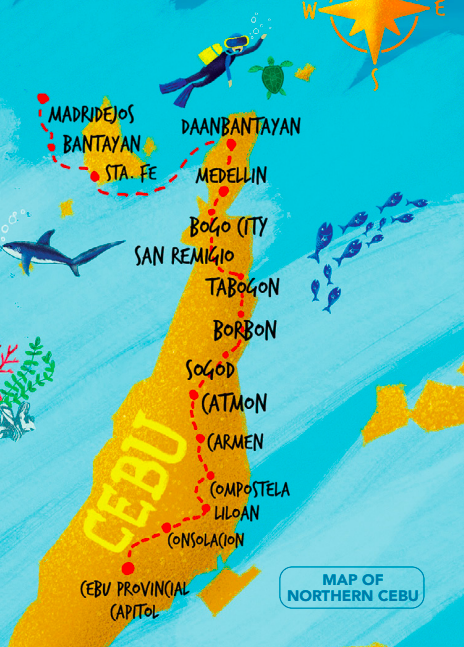
The Northern Escapade 2023 tour covering 15 localities was an exciting 3-day adventure, even for a longtime Cebu resident like me. A long line of air-conditioned buses parked beside the Cebu Provincial Capitol building were ready to board the 800 participants who had signed up for the tour, including 400 balikbayans, as well as foreign and domestic tourists. The tour guide assigned to each bus had 2 assistants on hand to attend to the passengers and ensure everything ran smoothly.
In addition, a local guide (oftentimes a public school teacher) from the next town on the itinerary would hop on to give a brief history and highlights of their town to share a glimpse of what to expect when we step off the bus.
DAY 1
CAPITOL Enthusiastic excursionists, including myself, assembled at the Capitol by 6 AM for our bus assignments and the orderly distribution of Suroy Suroy Sugbo loot bags. The thoughtfully- put together bag held essentials like a sun visor, umbrella, rubbing alcohol, and even a spare eco bag for all the souvenirs and goodies we would pick up along the way. Also inside was a copy of EATZ Cebu quarterly magazine, the handy guide to Cebu’s dining scene.
CONSOLACION First stop on our northern adventure was the coastal municipality of Consolacion. Disembarking from the bus at the Region VII Police Training Center, we each received a sarok, a wide-brimmed conical hat made of thin bamboo strips and dried banana leaves that farmers of this once agricultural town used to protect themselves from the harsh sun and rain. The town celebrates the Sarok Festival in October, a colorful parade of street dancing showcasing this handmade bamboo hat and its many uses.
Welcome honors for Gov. Garcia and entourage with a display of drills were given by the police trainees. As the early morning start had most of us skipping breakfast, we obliged and eagerly accepted the painit (light snack) of local delicacies, sweet mangoes and delicious tablea. To our big surprise and delight, we were then ushered to a covered court where a full spread of fiesta food had been prepared for us which even
included lechon!
COMPOSTELA After the hearty meal we were off to Compostela where a festive atmosphere met us at Cascade Nature Park. Spread out around the park’s open grounds were bamboo stalls representing each of the town’s 17 barangays. A walk-through of the exhibits showed various local products such as Compostela’s specialty queseo, a white cheese made from fresh carabao milk. Another booth demonstrated on the spot how to make silhig lanot, a soft broom of palm fibers. Guests were treated to more eats then entertained by a cultural show of dances and local songs.
CARMEN The sightseeing tour had also turned into food trip as it seemed we were forever eating. And it was no different when we reached Carmen where lunch was a seaside event. The town celebrates its own Sinulog sa Carmen festival on the fourth Sunday of January and marks its 50th anniversary this year, making it even older than the bigger festival of Cebu City. Governor Gwen, as Cebuanos call her, joined other dancers and offered the traditional Sinulog dance ritual honoring the Santo Nino image during our Carmen stopover.
Some delicacies we tried were the freshly-made cassava crackers and a sticky rice cake that looked so familiar but made with an interesting twist, the blue biko. The Cebu Safari and Adventure Park finds its home in Carmen and visitors had the chance to see some of its colorful birds who gladly perched on guests’ arms for a photo op.
TABOGON An exhilarating welcome of beating drums met us upon our arrival at Seaside Park in Tabogon. Overlooking the waters with a view of the boardwalk, tents with colorful buntings created a fiesta-like atmosphere and provided good shade as we watched the short cultural presentation. Food stalls offered native treats
like ube champorado, chicharon, organic coco vinegar, farm produce and baskets made by the locals were displayed. Many local residents also came to meet and greet the governor who
headed the group of out-of-towners.
DAANBANTAYAN Local officials of Daanbantayan greeted us at the historic Sta. Rosa de Lima Parish Church whose original façade has remained since the church’s completion in 1886. At the Sunset Park just down the road, booths serving the town’s native delicacies and a cultural presentation were prepared for us. Its
open air park is the perfect place to catch an unobstructed view of the setting sun. Situated at the northernmost tip of Cebu Island, Daanbantayan’s sandy white beaches and clear waters make it an attractive destination for tourists. The tiny island of Malapascua nearby is a diver’s paradise because of its rich marine life and the daily sightings of thresher sharks.
MEDELLIN The day’s final stop was Medellin where we parked at a most unusual place – the Medellin Bamboo Forest, which was all lit up for our hosted dinner that evening. A manmade forest located in a sugarcane plantation, it is a relatively new attraction for the agricultural northern town which is known as the Sugar Bowl of Cebu. Rows of towering bamboos bending to form graceful arches and the rustling sound of leaves as the bamboo swayed gently with the breeze was extremely relaxing after a full day of
touring. The offer of free massages was so inviting but its lines were just as long as the queue to the restrooms. Others stations displayed Medellin’s basket products, delicacies and fresh farm produce with an exhibit showing the town’s various tourism offerings. A lively show of folk songs and dances while we enjoyed a delicious Filipino dinner and sipped sugarcane juice was a great way to end Day 1.
DAY 2
SAN REMIGIO Ready for an early start after breakfast at our respective accommodations, we then proceeded to San Remegio and converged at their Lapyahan Public Beach. The term lapyahan simply translates to shoreline and the town takes pride in having Cebu island’s longest one. Being a coastal town, the sea is very much a part of the lives of its residents. The annual Lapyahan Festival in May features a parade of colorful props and street dancing with steps that reference the sea. Here we got a taste of swaki (sea urchin) plucked straight from the waters by local fishermen and cut open for the adventurous among us to try. Fresh seafood was a huge treat for everyone, not to mention the lechon baboy and lechon baka that was roasting on several open pits and served to all the guests. Back on the road again, we headed straight to Hagnaya Port where our caravan drove on to 2 large barges that took us across the channel to Bantayan Island. The one-hour ride was smooth and easy as we sat comfortably in our seats on the bus and chatted away with other passengers. Daily ferry trips run regularly for those who don’t bring their own vehicles.
SANTA FE Sante Fe, with its main ferry port, serves as the gateway to Bantayan Island. As we left the wharf, we were rewarded with a beautiful seascape of white sands and clear blue waters. This was the same stunning view at our beachside picnic at La Playa & Mayet beach front, one of many resorts dotted along its 17-kilometer long shoreline. The venue was ideal for our tropical island fiesta where tables were set up under the shade of coconuts trees. City guests were overwhelmed with the island cuisine of grilled meats and food stations overflowing with the freshest catch from the sea — lobsters, crabs, scallops, fish and gusô. A choir pleasantly
serenaded us from the side, then a fully choreographed cultural dance with colorful props was performed right on the sandy beach with the sea serving as the spectacular backdrop. This coastal town’s main industries are fishing,
agriculture and tourism. A favorite destination for beach lovers particularly during the summer months, Santa Fe will soon have an airport.
MADRIDEJOS Warm hospitality and friendly smiles of the islanders of Madridejos were clearly evident as they received us at the Kota Heritage Park, the site of a Spanish-era fort that overlooks the beach. One of Bantayan’s three municipalities, Madridejos is a rich fishing community and a major supplier in Cebu of fresh and processed seafood, dried fish as well as chicken eggs. It was no surprise then their buffet spread held an abundance of assorted seafood offerings like shells, oysters and crabs with grilling stations of squid and fish among others.
Underscoring its Uniquely Madridejos brand, dancers gave us a peek of the town’s annual Isda Festival as they performed on the stage set up on the beach. Several local fishermen waved to the visitors on the shore from their colorful boats. The LGU officials proudly escorted the governor over the town’s newly completed Bontay Walk.
BANTAYAN Fronting the St. Peter and Paul Church, the town plaza of Bantayan was all decked and ready for our arrival. Its historic church was open to all visitors who wanted to see the interiors and its intricate ceiling paintings while others used the free time before dinner to buy pasalubongs of buwad (dried fish) at their public market. Guests dined al fresco at the fully lighted plaza where seafood appetizers like their caramelized pusit, crab relleno, and spicy kinilaw topped with crispy dilis are worth mentioning. As in any special occasion, lechon was also on the menu. An air of excitement prevailed while waiting for the evening’s entertainment.
The elaborate cultural show started with local folk dances where the backdrop was its centuries-old church.
Then all eyes were focused onstage for the fashion show featuring the creative talents of Bantayan’s local designers which drew a round of applause and ended our Day 2 on a high note.
DAY 3
CITY OF BOGO Having boarded the ferry we were back on the main island of Cebu and continued our drive to Bogo. The rhythm of drums welcomed us as we stopped at Kapenarra and its Z&G Bonzai Garden, a recent attraction for the city. The LGU prepared a video presentation about Bogo, which became Cebu’s sixth component city in 2007. A short program of Filipino folk dances and music was the lunchtime
entertainment. Native dishes like kinilaw na puso ng saging and nangka kinilaw were served, and of course, the town specialty, pintos. Made with fresh young corn, milk and sugar and traditionally wrapped in corn husks, the popular delicacy is a must-try.
BORBON Carrying baskets of various delicacies, the smiling locals waved and greeted us as we made our way to the church plaza of Borbon. A serene coastal town whose source of income is
fishing and raising livestock and crops, coconut is among its main products. With true provincial hospitality, the native snacks served to us were all made with farm-grown ingredients. These included everyone’s favorite bananacue, cassava cake, and strips of sweetened coconut called bukayo. The most popular food stall was the one serving tuba, a mildly fermented local coconut wine which is proudly featured in Borbon’s Tuba Festival. Cups of warm tablea, a local chocolate drink, were also offered with or without a dash of tuba. Students entertained us with folk dancing while traditional Filipino childhood outdoors games were put on show while we enjoyed our afternoon treats.
SOGOD Cebu’s northern town of Sogod was proud to host the Suroy Suroy Sugbo participants at its newest attraction, the sprawling El Mar Resort. Refreshing watermelon, one of the agricultural town’s produce, was served upon our arrival along with other local treats like halo-halo, torta and budbod. The beachfront reception was at the resort’s cove where folk dancers performed just steps away from the water’s edge. Rattan and abaca products made by the town’s talented weavers were up for display and sale. Sogod is the Cebuano word for beginning and with its stretch of white sand and pristine beaches, the town stakes its claim as being the place in northern Cebu where fun and
adventure starts.
CATMON The quaint municipality of Catmon said to be named after the big catmon trees that grew abundantly in the area is more popularly known for its local specialty, budbod kabog. This sweet
treat is made of a species of millet that thrives well in the mountains of Catmon. Folklore says cave bats would feed on this millet that farmers later began calling this cereal grain kabog (Cebuano term for bat). The delicacy is the star of the Budbod Kabog Festival during
its annual town fiesta which features a parade and street dancing. At Tyche Beach Resort a stage was built on stilts right on the waters to give visitors a full view of the presentation by Catmon’s performing arts group. Their dance
featured the different steps taken in the preparation of this town specialty.
LILOAN The grandest welcome party was set for us in Liloan, the very last stop on our 3-day Northern Escapade. Held at the municipal plaza, the town hosted dinner and showcased Liloan’s rich culture, products, food and talent. Gov. Garcia expressed her thanks and congratulations to all the participating LGUs for making the
Suroy Suroy Sugbo Northern Escapade a huge success by showing the 800 visitors and guests the best of Cebu. The event was made more special by the presence of Department of
Tourism (DOT) Secretary Christina Frasco who graced the occasion. The tourism chief couldn’t be happier to make the announcement in her very own hometown of Liloan that Cebu’s Suroy Suroy Sugbo initiative will be replicated as a national tourism program throughout the country and will be called “The Philippine Experience.”
For more information on succeeding Suroy Suroy Sugbo tours, please contact: Cebu Provincial Tourism Office 3rd Floor Capitol Bldg. Escario St. call 888 2328 local 1130 or 1133 or 1134 Look for Ivy/ Lino/ Cesar.Or send a message through Facebook: Suroy Suroy Sugbo
www.facebook.com/suroysuroysugboofficial
Cebu Provincial Tourism Office
www.facebook.com/CebuTourismOffice